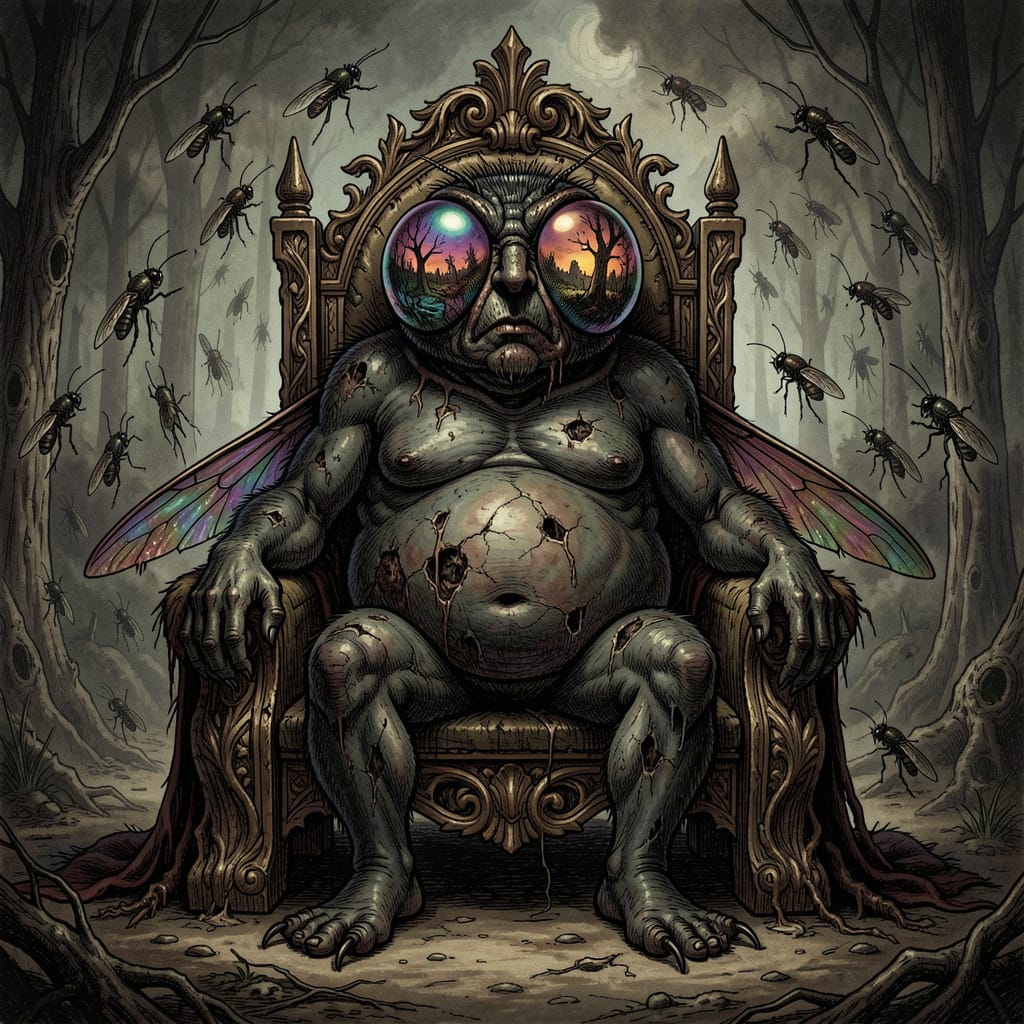
Beelzebub

Beelzebub — gluttony among the Seven

Lore Profile
ClassificationOne of the Seven
Sin CorrespondenceGluttony (Gula)
OriginHebrew Ba‘al Zĕvub — "Lord of the Flies"; the god of Ekron
KingdomThe Maw — see the Seven Thrones
StatusContained — as of the events of Cambion
First AppearanceCambion, Book One · Book of Thoth Saga

Beelzebub

"Lord of the Flies — the name the record returns to, century after century."


Overview

Beelzebub is one of the Seven, corresponding to Gula — Gluttony. Known across the tradition as the "Lord of the Flies," he began as a Philistine deity and rose, by the time of the New Testament, to be named the very prince of demons — a promotion from local idol to cosmic adversary that no other member of the Seven quite matches.

His domain is gluttony, but understood in its fuller theological sense — not merely over-eating, but consumption beyond need: appetite that runs past satisfaction into compulsion, the turning of any desire into a hunger that devours its bearer. His emblem, the fly, is the creature of decay and swarm, feeding on what rots and multiplying without limit, and it is a fitting sign for a sin whose nature is to consume without end.


Etymology & Name

The name Beelzebub derives from the Hebrew Ba‘al Zĕvub — "Lord of the Flies" — the form given in the Book of Kings to a deity worshipped at the Philistine city of Ekron. It is widely held to be a deliberate Hebrew corruption of Ba‘al Zĕvul — "Lord of the High Place," or "the Exalted Lord" — the dignified title of the god repointed with zĕvub (flies) to mock and degrade a rival cult. The insult is etymological: an exalted lord reduced, by the change of a single vowel, to a lord of vermin. Whether the entity preceded the corruption or was created by it the texts do not resolve. In the Greek of the New Testament the name appears as Beelzeboul.

Mythological Origins

The name first appears in 2 Kings 1, when Ahaziah, king of Israel, injured in a fall, sends messengers to consult Baal-Zebub, the god of Ekron, to learn whether he will recover. The prophet Elijah intercepts them: "Is it because there is no God in Israel that you are going to consult Baal-Zebub, the god of Ekron?" — and pronounces the king's death for the idolatry. Here Beelzebub is a rival deity, a false god set against Yahweh, and his defeat is the defeat of the foreign cult.

By the New Testament, Beelzebub has become the name for the prince of demons himself. In Matthew, Mark, and Luke the Pharisees accuse Jesus of driving out demons "by Beelzebub, the prince of demons" — and the accusation, in the logic of the text, is also a naming of the highest demonic authority. Whether they mean Satan or a distinct figure is left theologically unresolved; Jesus' reply disputes the method, not the hierarchy. The Testament of Solomon has Beelzeboul confess that he was once a leading heavenly angel, associated with the evening star, and that he now works destruction through tyrants, incites the worship of demons, and stirs jealousy, murder, and war.

In John Milton's Paradise Lost, Beelzebub is Satan's second-in-command — the first named among the fallen after Lucifer, the one who speaks the rebel cause most clearly in the council of Hell, cold and deliberate and strategic. He does not rage; he plans. The demonological classifications divide on his sin: the fifteenth-century Lanterne of Light assigns him Envy, while Binsfeld's 1589 classification — the one the Seven follow — assigns him Gluttony. The occult tradition names him chief of the "Order of the Fly," and the Ars Goetia describes him as a Great Prince appearing as a monstrous fly, commanding many legions of spirits.


The Most Documented Demon

What distinguishes Beelzebub in the historical record is his sheer legibility. Where the other members of the Seven work through inducement and indirection, Beelzebub is the entity most frequently named outright in the documented cases of possession — the one who leaves the most evidence of his passage through human bodies. From the Renaissance witch-trials through the great convent possessions to the modern cases, it is his name the record returns to, century after century.

Whether this frequency reflects genuine activity or mere recognisability — whether he is the most active of the Seven or simply the most identifiable, the name most readily reached for by an exorcist confronting something unnamed — is a question the tradition never settles. The Lord of the Flies is, appropriately, the demon who cannot help but be seen: the one whose presence, like the swarm that is his emblem, announces itself.



Beelzebub in Aethereal Stories — Gula among the Seven In-universe lore. Contains worldbuilding and spoilers for the Book of Thoth Saga.

Within the Book of Thoth Saga, Beelzebub holds the office of Gluttony among the Seven and rules the kingdom of The Maw within the Seven Thrones.


The Possession-Pattern Analysis

Declan Marsden's private compilation — photocopied clippings and incident reports spanning centuries, the oldest ink faded to sepia — lists Beelzebub across five incidents: Nicole Obry at Laon (1566); the Ursuline nuns at Aix-en-Provence (1611); the mass possession at Loudun (1630s); Anna Ecklund in Iowa (1928); and Anneliese Michel in Germany (1976). It is not a Beowulf document but a map Declan has built toward a conclusion: that the 1987 Christine Knight incident belongs in this sequence, and that the sequence is a pattern rather than a coincidence. Beelzebub's presence across five of the entries gives the pattern its historical depth.

The notation "no children" recurs in the list — at Anna Ecklund and at Anneliese Michel, whose case in 1976 is the most recent prior to Christine Knight. The 1987 entry departs from the pattern: it ends not with "no children" but with a child delivered stillborn. That departure is the thread Declan has pulled at for nine years.


Status in the Saga

At the point of Cambion's events, Beelzebub is among those Amy designates as contained — the containment qualified, as always, with "for now." His historical range, the scale of the incidents attributed to him, and his apparent capacity for both individual possession and mass events place him at a different operational tier to the more targeted interventions attributed to Asmodeus in the Knight case.


Trivia

  • Declan's late-night reading of the file produces a moment of disorientation: a sound he cannot place, something present and wrong, and then the word on the page — Beelzebub. Or Beowulf. Or something that knew he was watching and wanted him to know it was watching back. The two names — one demonic, one the organisation he works for — share enough letters to momentarily blur in a tired man's vision. The saga does not comment on this. It sets it down and moves on.
  • The 1976 Anneliese Michel case — in which Beelzebub is named alongside Lucifer, Judas, Cain, Nero, Hitler, and Fleischmann across 67 exorcisms — is the most recent documented incident in Declan's pattern prior to Christine Knight. The subject died. No children. The notation no children appears twice in Declan's list: at Anna Ecklund and Anneliese Michel. The 1987 Christine Knight entry, which ends Child delivered stillborn, departs from this pattern. This departure is the point.
  • The degradation of the name is etymological as well as theological. The dignified Canaanite title Ba‘al Zĕvul — "Lord of the High Place," or "Prince Baal" — is preserved in the Ugaritic texts as an epithet of the storm-god, and the Hebrew Ba‘al Zĕvub ("Lord of the Flies") is widely read as a deliberate scribal pun that reduced an exalted rival deity to a lord of vermin by the change of a single consonant. The Greek of the New Testament, Beelzeboul, appears to preserve the older "Zebul" form beneath the insult.

Appearances

TitleRoleNotes
Cambion
Book One · Book of Thoth Saga
Historical Pattern EntityNamed across five entries in Declan Marsden's possession-pattern analysis (1566–1976). Designated contained by Amy. The most historically documented of the Seven in the evidence Declan has assembled.
Hope's End
Book Four · Book of Thoth Saga
MentionedDetails forthcoming.
The Divine Ring
Book Five · Book of Thoth Saga
MentionedDetails forthcoming.